

Martha at the Bar
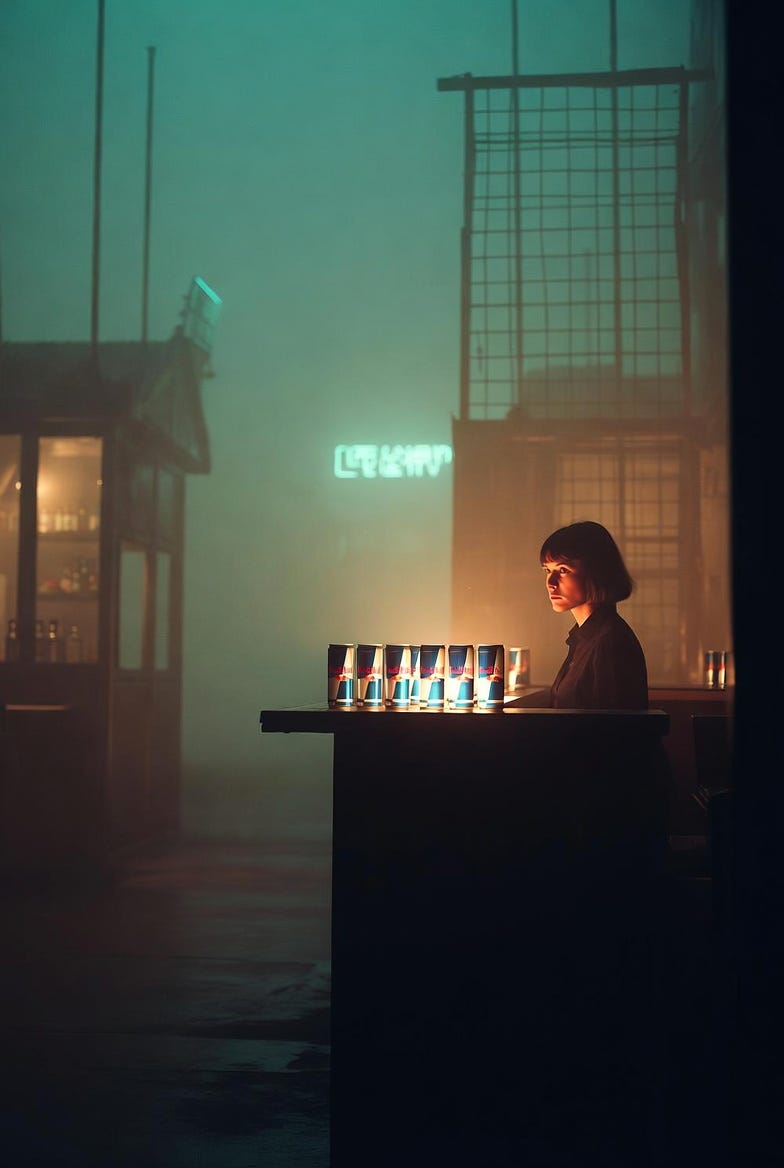
The bar exists provisionally sideways, in peripheral vision, between two unclear establishments. You find it when you’re not looking directly. Liliana has been behind it since before it existed. Installed with the fixtures. Buck enters sideways. Sits. Martha regards him with the disinterest of someone who has catalogued every variety of desperation. “What are you drinking?”
“What do you have?”
“Everything. Nothing. The usual Train Station inventory.”
“Red Bull.”
“American or the other kind?”
“Is there a difference here?”
“There is always a difference. The difference is the point. If no difference, no transaction. If no transaction, no final Station. The final Station is difference monetized.”
She pours. Buck drinks. It is Red Bull in the way the Zone is a city technically accurate, broadly misleading. “You’re waiting for someone,” she says without looking. “How do you know?”. “Everyone in the Station is waiting. The Station is a waiting room. Large, elaborate, good soft drinks, appalling plumbing. Those not waiting have left. Those here are waiting.”
“And you?”
“I am the waiting room. I don’t wait. I contain.”
Karma enters. Not Ramsgate, not Stroud, but secondhand urgency.
“Marta.”
“Karma. You’re early.”
“Time in the Station is bureaucratic fiction.”
“Then you’re on time.”
“Your package was delivered,” she says.
“Which package?”
“The one you don’t know about. It arrived before you sent it. Pure Train Station irregularity.”
Karma appraises Buck.
“You’re the asset.”
“I prefer traveler.”
“In the Zone the distinction is semantic. An asset travels. A traveler is an asset. The Control Board does not recognize independent movement.”
The Car with No Engine
He was sixteen the year “the floor Gave Out”, and it gave out the way Floors always do in the stories that matter: not all at once, not with a sound you could point to afterward and say: “there”, that was the moment, but by degrees, a board at a time, until one morning he understood he had been standing on nothing for a while already and simply hadn’t looked down.
His father remarried, and that was the sentence the whole rest of his life would end up footnoting. No scene of shouting, no door slammed hard enough to remember the sound of just an absence opening up where a house used to be, and underneath the absence, no safety net, no references, nothing that the word family could be reasonably asked to cover anymore. He understood, with the flat clarity that arrives sometimes in adolescence faster than it has any right to, that he was now a problem that had been solved by subtraction.
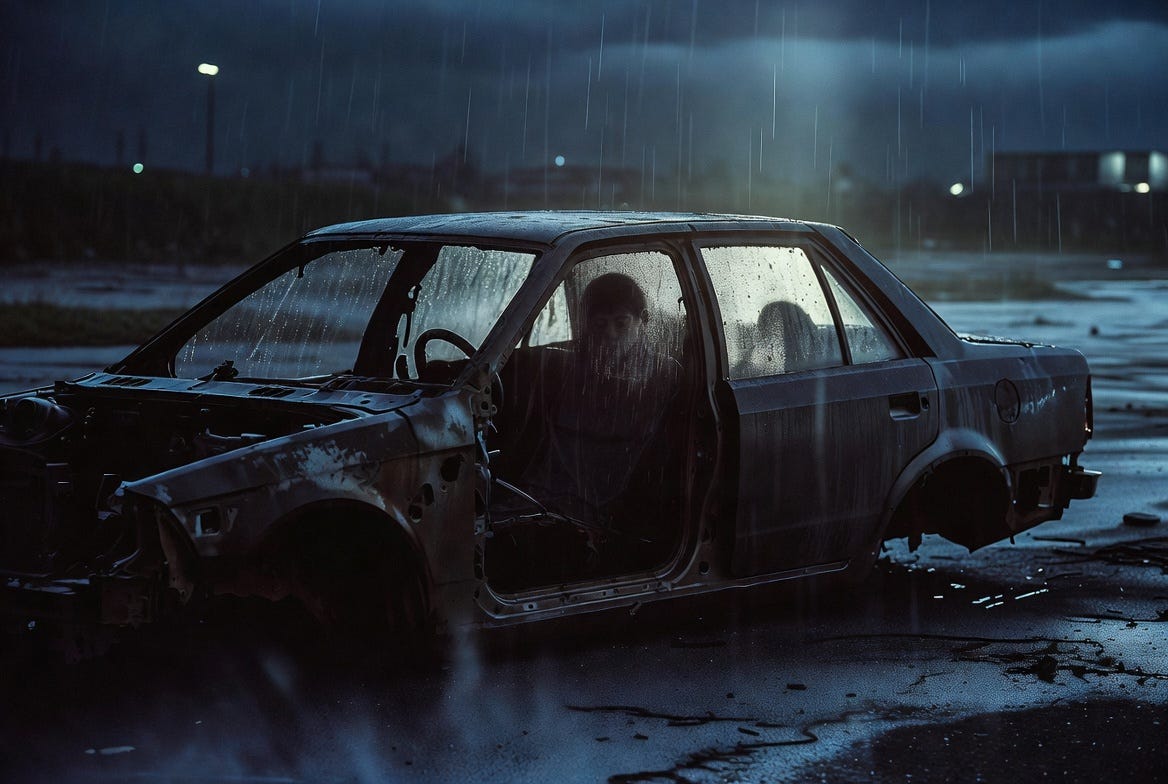
The car had no engine. That detail he would carry for the rest of his life the way other men carry a scar they can show people not because it was the worst of it, but because it was the part that could be said in one sentence and still convey the whole shape of the thing. A car, gutted, going nowhere, parked wherever a car with no engine is permitted to sit and rust without anyone troubling to ask why. He learned to sleep in it the way you learn anything at sixteen with no one teaching you: badly at first, then less badly, the body negotiating its own terms with the cold because no one else was available to negotiate on its behalf.
He learned to eat on a schedule that wasn’t a schedule. He learned which doors in which neighborhoods opened a crack further than others. He learned that mercy, when it showed up at all, showed up briefly and asked for something in return, and that the asking was never written down anywhere a sixteen-year-old could read it in advance.
Heroin found him there, in the gutted car, in the no-engine nights and he was careful, later, writing it all down, not to dress that meeting up as anything other than what it was. It didn’t find him because he was weak, or because he was looking for ruin. It found him because it was the only thing in that particular stretch of his life that turned the roar down. The aloneness had a sound, he would say afterward, a constant low frequency under everything else, and for a while the only tool available to quiet it came in a folded paper and cost him pieces of himself, he wouldn’t be able to identify the bill for years, until decades later.
Prison came the way it comes for boys like that not as a single dramatic reckoning but as the System’s particular method of bookkeeping, concrete and time and the specific erasure of a person who has already, in every way that matters to the people doing the erasing, been written off in advance. He did not romanticize it afterward, and he asked, in the writing, that no one else romanticize it on his behalf. It was lost time. It was a roof, at least, and walls, and underneath the relief of that he understood exactly what he was being relieved from feeling.
Eighteen months in rehab turned out to be the axis the rest of his life would eventually turn on, though nothing about those eighteen months felt, while he was living them, like an axis. It felt like the slowest, least cinematic war he would ever fight no crash, no courtroom, no “Lord of Lies or Lord of Flies” arriving in Molten Honey to make the stakes legible.
Just months, just the daily decision, renewed every morning with no guarantee it would hold past noon, that the streets and the needle would not get to write the last page. He had no family standing behind that decision. No one was coming to catch him if his hand slipped. He made the decision anyway, on no collateral but his own continued presence in the room.
Thus, he went back to school with nothing but the decision and the stubbornness underneath it.
Finished what should have been finished years earlier, on schedule, by someone with a safety net. Then further a BBA, international business, marketing, the discipline of two languages instead of one and further still, he than brought on the graduate work in Data and Statistics, because somewhere in the long climb out, he had discovered something almost funny about himself: that the part of his mind which used to read a room for danger on the street could be retrained, with enough patience, to read a Balance spreadsheet for risk in a Boardroom, and that the two skills were Closer Cousins, than anyone teaching the graduate classes seemed to suspect.
He built it all on early mornings and late nights and the specific, unglamorous knowledge that there was no safety net waiting under any of it that if he slipped, the floor that had given way at sixteen had never been rebuilt and wouldn’t catch him this time either.
He did it anyway. Not because it made a Good Story. Because the alternative was the gutted car and the Fucked Up Engine, and he had already done the gutted car… and he was not going back.
Years later, caring for his mother through the cancer and the rare illness underneath it, paying for what the NHS System wouldn’t cover, watching five years of their shared history scatter into a chaos he had three days’ leave to manage and then lose he would think sometimes of the boy in the car with no engine, and understand that the boy had never really left.
He had just learned, eventually, expensively, to fight the same “Machine” from inside a suit instead of a back seat.
The kid who slept in a car that couldn’t go anywhere grew into a man who crossed borders for a living, who closed deals in rooms that would never have let the sixteen year old version of him through the door. Both were the same person. He was careful, writing it all down, never to pretend otherwise.
The Maternity Ward Basement
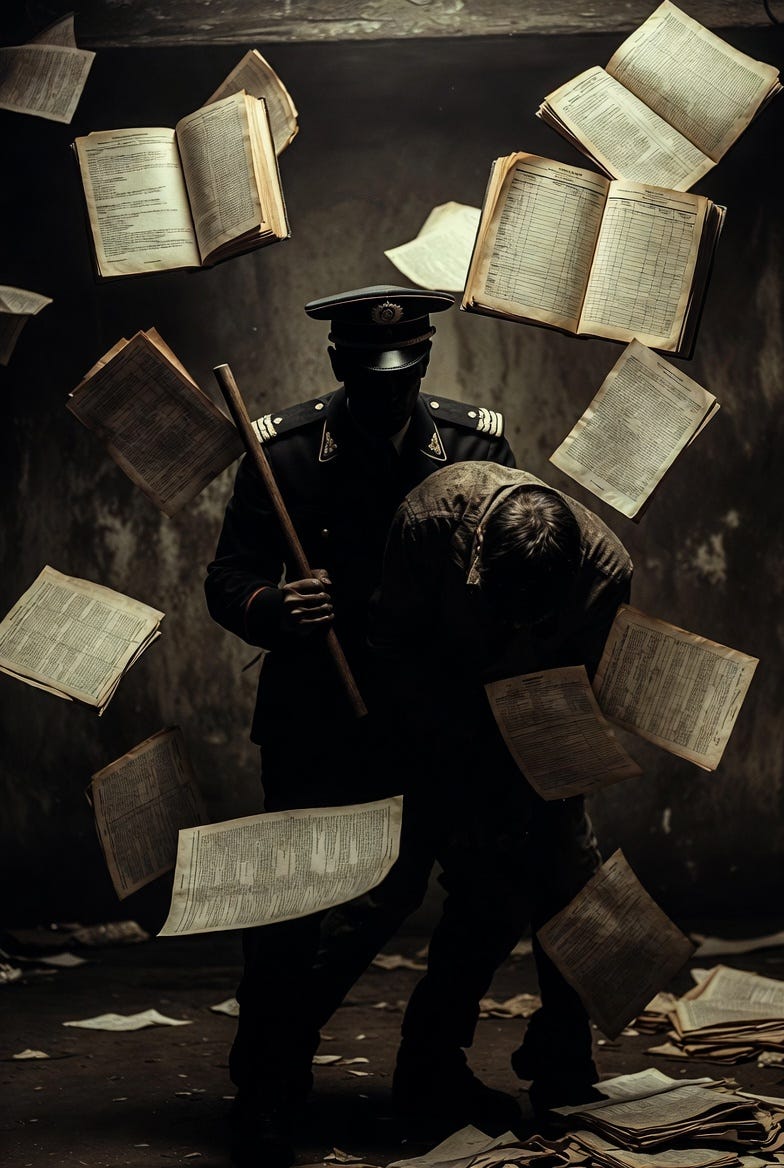
… “Hold the cunt still.” The Officer reset his grip on the truncheon with a small grunt, an almost domestic sound, the sound of a man adjusting his hold on a hammer before the next nail.
His breath, when it passed close to Buck’s face, carried the warm bitterness of bad Espresso laid over older, deeper tobacco. “Thinks he’s an artist, this one. Do a Good Job!”
The Judge
“This Court,” the Judge said at last, not looking up, “has heard forty years of men who Broke the Law because the Law broke something in Him first. It is not this court’s place to settle which came first, in your case: “the Law or the Breaking.”
He closed his eyes briefly not in prayer, nothing so generous, more the brief shutter of a man checking some private ledger of his own. “But I will note for the record that the defendant has, throughout these proceedings, declined every invitation this court extended toward leniency, and has instead insisted, repeatedly and at some apparent cost to himself, on being exactly what the file says he is.”
The Confession
“I fought dirty because life, from the first breath, Life tried to take me apart, and I decided early too early, with too little information that the only available response was to take it apart first.
The thing I’ve been calling in these pages, “a Redeemed Criminal”, was not born because of nature. He was molded by necessity. He was forged, slowly, in the refusal to become one more Discarded Collaborator… one more Fabio though: stabbed seven times because by then the Arithmetic of Power no longer favored his survival and Nobody Important was doing the math on his behalf. I refused the patch. I want to resist, here, the temptation to call that refusal “Heroic”, because it wasn’t... it Wasn’t at all… It was incapacity wearing the only clothes I had. I simply could not do the thing that was being asked to me: Bend, Comply, be predictable! And… I have spent a great number of years since then, deciding whether to be Proud of that inability or simply to live inside it, the way you live inside a fucken deranged vehicle with no engine.
The Reconciliation of the Apex
“Sammasati,” he said. “Right Mindfulness”. The full recollection that doesn’t flinch from what it recollects. Satorim, arrives the way the Crash You had with Your motorbike did: sudden, unrequested, tearing the veil… before you’ve agreed and consent to having it torn. One moment you’re meat behind a steering wheel. The next You are nothing.
But it isn’t enough on its own. One satori, ten Satoris, they flare and they fade if the architecture underneath them… The Phenomenon remains a prisoner of Itself. That’s where the rest of it must be spoken, I do not surrender, I do not forget, You won’t have me even with a shot in the back of my head to cowards to face me straight in the eyes…”
The Varisto Entertainment Team 4 …
Buck Thursday
BT is not a Freemason.

Thanks. I hope the Book will be a success. B. T.
Thanks Guy, I tried to reproduce the Kafkian disopian tone of certain chapters of the Book and consequently writing an intro just using that specific voice. Thanks again