
VIP
They called him a “Consigliere”

Buck was used to stumble across those labelled “prominent”, “important”, “influent” people... It was a routine typicl of his demeanor and that of his own Family (They called him a “Consigliere”)
“An occult Cartography of Soul, Memory, and Unpredictable Vision”
This is not random literary tourism:
This Buck’s short story was born due to the frustration of understanding that an infamous Typist like Truman Capote, stolen and copyrighted the title he would have used for his first Book; “In cold Blood...”
“Guelphs and Ghibellines, “Montagues and Capulets”... Don’t fuck with an Italian.
Bucks thought: “Why life undeniable cruelty should conceived me as a “Consigliere?”
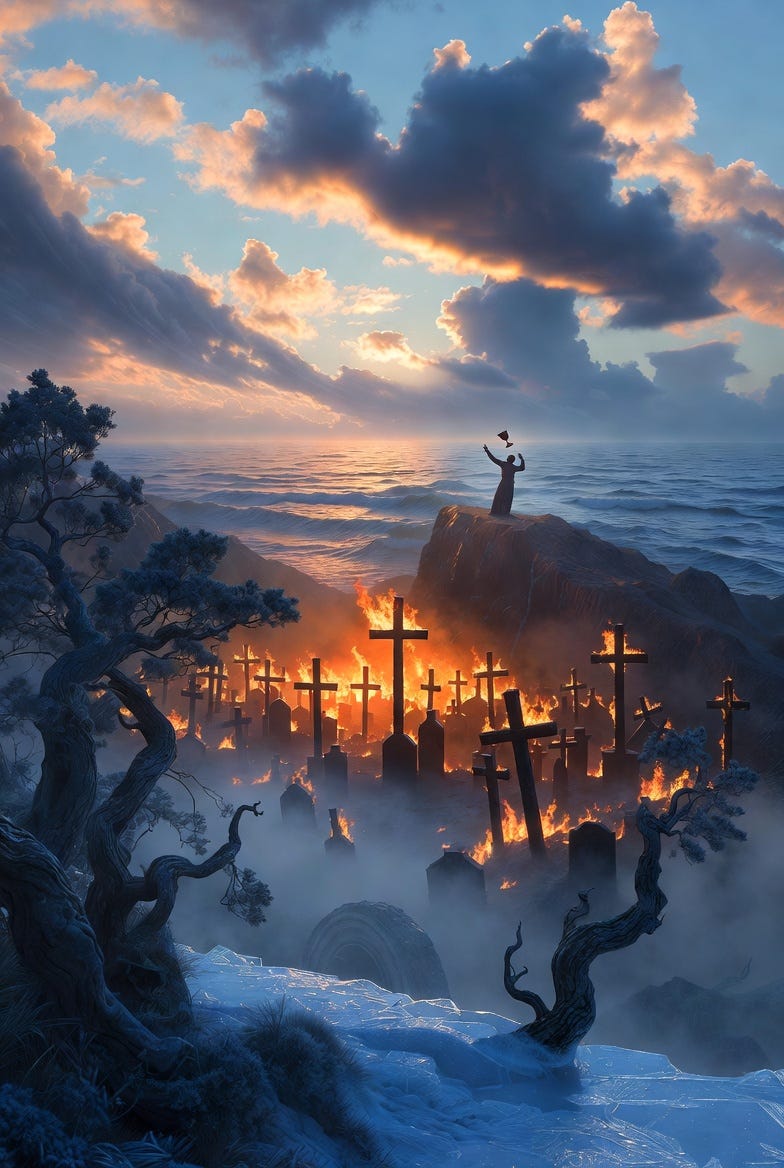
“At the heart of this liminal landscape lies an endless sea of amazing beauty vast, luminous, indifferent, and inexhaustible. Into its depths we cast our most precious objects: golden goblets, doctrines, even bodies. Yet nothing is ever truly lost. The sea receives, holds, and unpredictably sometimes returns what was given to it.
This is not the cleanly delineated Inferno of Dante, but a northern, liminal realm where the usual boundaries dissolve:
life ↔ death
presence ↔ absence
foresight ↔ blindness
It echoes the fiery cemetery of the heretics in Inferno Canto X, where the entombed souls speak with piercing clarity about distant events while remaining blind to what stands immediately before them. Yet here the fire has cooled into something colder, mistier, more psychic: the inner space of a modern speaker who still feels vividly, insistently the presence of someone who is no longer corporeally there.
“It’s not easy… feeling you here with me when you’re not really here.”
The dead, in this cartography, are more alive, more conscious, more awake than they (or we) ever claimed possible. They speak. They rise. They foresee remote futures with uncanny accuracy yet the present eludes them entirely.
A single, intrinsic thread binds every fragment of this vision:
the persistence of the soul against its own denial.
One emblematic figure stands out: the king who remains faithful to his dead beloved long after her body has vanished. Years pass. Grief calcifies into ritual. Eventually he takes the goblet associated with her memory—the last tangible relic—and hurls it into the sea.
This is not closure.
It is apotheosis.
The act does not banish her; it surrenders
her fully to the endless sea of beauty, trusting (or gambling) that what is given to the infinite cannot be annihilated.
And here the keystone word arrives: imprevedibile (unpredictable).
It seals the entire vision.
We can reliably predict only one thing:
that we cannot predict the decisive moment.
When the absent returns in sudden, overwhelming feeling
When the confident prophecy fails up close
When the sea gives something back or swallows it forever
Imprevedibile ah, there’s the word, the keystone, not some mere chaos tumbling like dice in a drunkard’s fist, but the final, occult statute inscribed upon the very parchment of soul, memory, and that treacherous faculty we call vision. The one certainty vouchsafed to us poor mortals is radical uncertainty at the instant that matters most—the moment when the veil twitches, when the absent beloved surges back in a hot flood of feeling, when the proud prophecy stumbles blind at the threshold, when the sea, that endless glittering northern waste, either regurgitates its treasure or gulps it down for ever.
In this liminal northern sea, then, we navigate not by any sane cartography but by the taut, quivering wire strung between what the viscera know to be true and what the intellect can never quite grasp—between the stubborn fidelity of what was loved (Beatrice, the goblet, the soul itself) and the beautiful, merciless, laughing unpredictability of what returns, if it returns at all.
“Look—here is the sensation again. Do you recognise it without my having to name the damned thing outright?”
The thread, the real nerve, is this perpetual haunting by what is not yet here, or no longer here: the discovery that such spectral visitations are no illusion, no cheap phantasmagoria, but the surest evidence we possess of something enduring beyond the visible, the rational, the predictable. A ghostly fidelity that laughs at denial.
And I to him: “I come not of myself; he who waits there leads me through here, perhaps the one your Guido held in disdain.”
There it is—the unspoken fracture, the real wound at the heart of the whole sequence. The friend’s rejection of the salvific path that Dante so ardently embraces: Guido Cavalcanti, the ultimate absent presence, the ghost whose lofty disdain haunts every meditation on immortality, on prophecy, on unpredictable absence, on the endless sea where fidelity to the beloved persists, defiant, beyond loss or negation.
Buck was riding his bike that afternoon, the Maryland air crisp with the false promise of spring, when an unwanted thought wormed its way in, unbidden and sour:
“They see distant future events with hideous clarity. They are blind to the present. Poor fuckers, poor losers. No prayers for the dying they’re already dead.”
A prophet glimpses Dante’s exile in sharp relief but cannot grasp the shoe on his own foot. The “question resolved” in Canto Ten that very mechanism of partial prophecy, of haunting presence/absence threads the entire assemblage like a black vein through marble. Did you understand? It’s the perpetual cycling of denial and paranoia, round and round the fiery tombs.
Buck’s mind flicked back to the gloss on the tenth canto: “In which is treated the sixth circle of Hell and the punishment of the heretics; and in the form of prophecy, through the person of Messer Farinata, many things are foretold including those that befell Dante and a question is resolved.”
Resolved, indeed. The damned see far, see nothing near. “This is merely my future. It has already been written.”
Among all those reach guys real billionaires, influential rare personalities one stood out with a specific connotative vile and risible attitude. A real piece of shit. His passion? Polishing a statue of Rudolf von Sebottendorf in the middle of his villa’s garden, got up like a Boy Scout sporting Nazi badges. “Fucker… lowest form of life on this planet.”
Poor, influenceable souls in the corridors of the lab would whisper to one another: “He’s impossible… but when the real crisis comes, he’s the only one you want in the room.”
Generally defined as: independent grand strategist and geopolitical consultant who runs his own high end advisory operation the ultimate private think tank for presidents.
Buck labelled him privately: little guard dog.
His large, quietly elegant house in a leafy Maryland suburb just outside Washington the kind of place that looks ordinary from the street but inside holds a Nietzsche totem in the bay window and a tall metal statue of Claus von Stauffenberg in the garden. No alarm clock; his internal clock, honed by decades of reading the world’s pulse, simply opens his eyes at the appointed hour. “Paranoid Nazi brainwashed loser” that was the first unfiltered thought whenever Buck conjured him.
Mornings: Le Monde first (“because, as he has said for years, it is still a real newspaper”), then the Wall Street Journal cover to cover with pencil in hand, marking what the rest of the world will miss (or, to put it plain in his obnoxious mind, what the rest of the world is too stupid to see). Then quick scans: Japan Times front page, Korea Herald, Jerusalem Post (and Haaretz purely for the amusement of watching people tie themselves in knots). If Europe stirred, add Süddeutsche Zeitung and the Daily Telegraph. All this before most had finished their first coffee.
His wife, Shoshana, an Israeli artist (whose cooking he trusted completely, no need to labour the point), brought him strong tea at the kitchen table while he was already at the computer in his study. From there the real work: hours scanning open source intelligence, writing sharp private memos for clients, taking encrypted calls from foreign ministries or corporate boards hungry for his long-range forecasts. He treated the global news flow like an ongoing dark comedy, muttering sardonic remarks at the screen as he dissected why the latest crisis was predictable six years ago.
Afternoons for deeper writing or the occasional in person meeting in D.C. (he still flew when the client mattered enough).
Buck was drawn to just one thing about him: the calm, imperturbable way he would utter, “No, not like this.” Buck thought him a lucky fucker more than a real magician, yet real magick lurked in that spell, and Buck had always puzzled over how the little bastard had acquired it.
Outside in the garden the Stauffenberg statue kept silent watch under the Maryland stars.
Buck laughed, recalling the moronic perseverance with which he’d draw out “from the waist up…” to end a strategic conversation, or dispatch to incredulous eyes or brown nosing agents gaping in some temple: “I craft tailored two-to-five-page reports via encrypted email just for Foreign Ministry or Fortune 500 board…”
“RK is tedious,” Buck thought, still grinning at the old remembrances. “Same bullshit as 2014,” “they still don’t get geography,” “predictable panic.” Typical nonsense utterances.
The hidden fuel: the exhaustion under the calm. He had admitted, in rare asides, that decades of constant warfare intel (post-9/11 covert stuff, Stratfor era) were “exhausting.” What a turd. Limitless decadent rotting embodiment of worthless flesh… the parasitic human.
Buck thought: “This is tedious, Paul. This means being tedious.” He nearly exploded with laughter.
That he was a Hungarian Jew whose parents lived through the worst didn’t justify what he actually was. (Not he.)
Aaron finally arrived. Buck was happy.
“How did it go?”
“Wonderfully. Top notch.”
“How…?”
“Top of the top.”
“Hey Aaron, d’you remember that parasite waste of society when we were still working for those fuckers at SISMI?”
“Which one?”
“The Hungarian?”
“Oh yeah… an example of human living shit.”
“Yeah, the one who made me eat human meat in Seoul, and who was making fun of me saying it was typical South Korean barbecue, dog meat… What a piece of shit.”
“He’s the same who was packing young karaoke girls knocked out on GHB and flunitrazepam and if I remember properly synthetic tropane alkaloids, then folding them to fit a large suitcase, packing them with scotch tape and having a servant get rid of the bodies, just because he thought: sacrificing a life brings luck and keeps the gods happy and protecting you.”
“I remember you had him pay five bottles of thirty year old whiskey seventeen thousand US a bottle driving around Seoul in five limos and picking up eight prostitutes for a thousand bucks each just to teach him not to play wrong tricks on a real… you know. A real us.”
“We are the only ones, brother.”
“What a waste of human life. God should be a soulless moron.”
Thanks Maestro... This means to me more than all the shit I have to bear on my back. U R making me a new real ME. Always in debt...